Together these technologies (each is separately explained) form a very scalable, faster, more redundant, more mobile network with optical route paths compared to traditional networking.
BGP (Border Gateway Protocol) is a routing protocol that enables the exchange of network reachability information among autonomous systems (AS) on the Internet. BGP allows each AS to determine the best path to reach a destination network, based on various factors such as distance, cost, and policy. BGP is one of the core protocols that enable the Internet to function as a global network of networks.
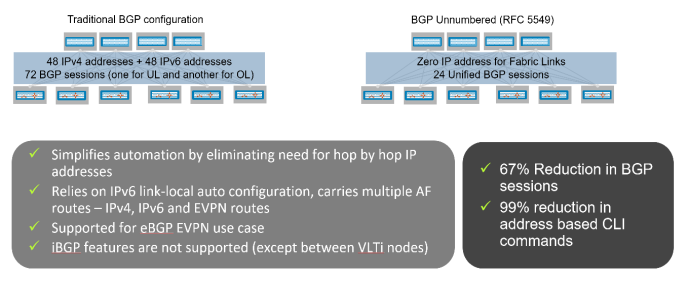
Unnumbered IPv6 interfaces with BGP for EVPN are a way to simplify the configuration and management of EVPN networks. With this method, each VTEP does not need an explicit IPv4 or IPv6 address, but instead uses a link-local IPv6 address derived from the MAC address of the interface. The link-local address is then used to establish BGP sessions with other VTEPs and exchange EVPN routes. This avoids the need to assign and maintain unique IP addresses for each VTEP, as well as the use of additional protocols such as DHCP or SLAAC.
VxLAN (Virtual Extensible LAN) is a protocol that encapsulates Ethernet frames in UDP datagrams, allowing layer 2 networks to be extended over layer 3 networks. VxLAN creates logical tunnels between different segments, identified by a 24-bit VxLAN Network Identifier (VNI).
–> VXLAN is the Data Plane – Traffic is encapsulated in VXLAN and sent between VTEPs based on the information learned via EVPN.
EVPN (Ethernet Virtual Private Network) is a type of VPN that allows different Ethernet segments (Layer 2) to be connected over an IP network (Layer3). EVPN uses BGP to distribute MAC address and IP address information among the participating routers, enabling efficient and scalable layer 2 and layer 3 services. EVPN also supports advanced features such as multi-homing, fast convergence, and integrated multicast.
–> EVPN is the Control Plane – It is responsible for the propagation of IP/Mac mappings and locations.
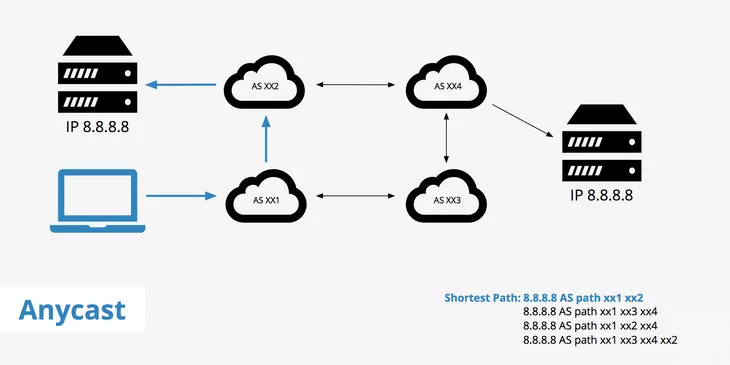
Anycast Gateways is a technique that allows multiple routers to advertise the same IP address from different locations, creating a distributed service (avoids hairpinning). This improves the performance, availability, and load-balancing of the service, as each client can connect to the closest router. Anycast with EVPN also simplifies the network configuration and management, as no additional protocols or tunnels are required.
–> Replaces FHRP
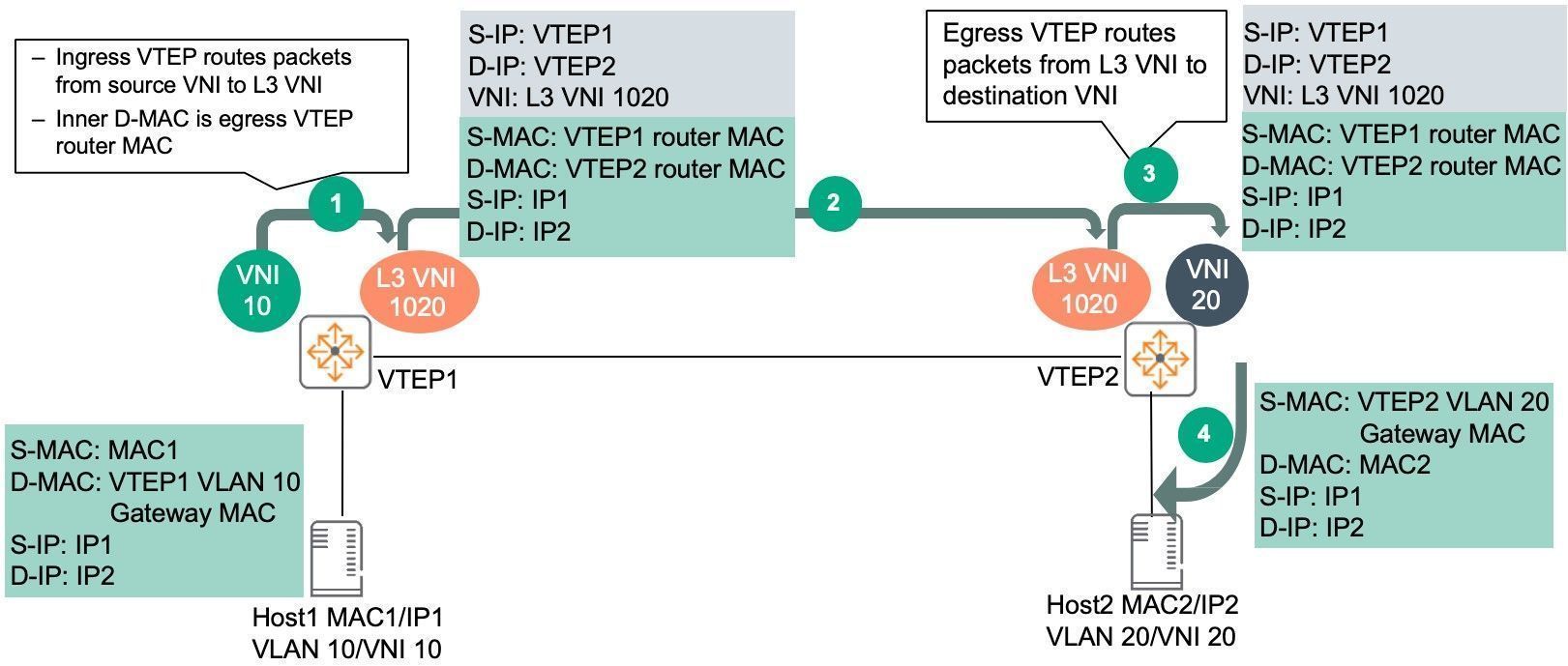
Symmetric IRB (Integrated Routing and Bridging) is a mode of EVPN that allows seamless communication between different types of hosts, such as VMs, bare metal servers, or routers. Symmetric IRB uses the same VNI for both layer 2 and layer 3 forwarding, and requires each VTEP (Source/Destination ; VxLAN Tunnel Endpoint) to perform both bridging and routing functions. Symmetric IRB provides optimal routing and switching paths, as well as consistent forwarding behavior across the network. Symmetric IRB also reduces the complexity and overhead of maintaining different VRFs and VNIs for each subnet.
–> Thus simplifying the routing overlay, more consistent and more scalable then Assymmetric IRB.